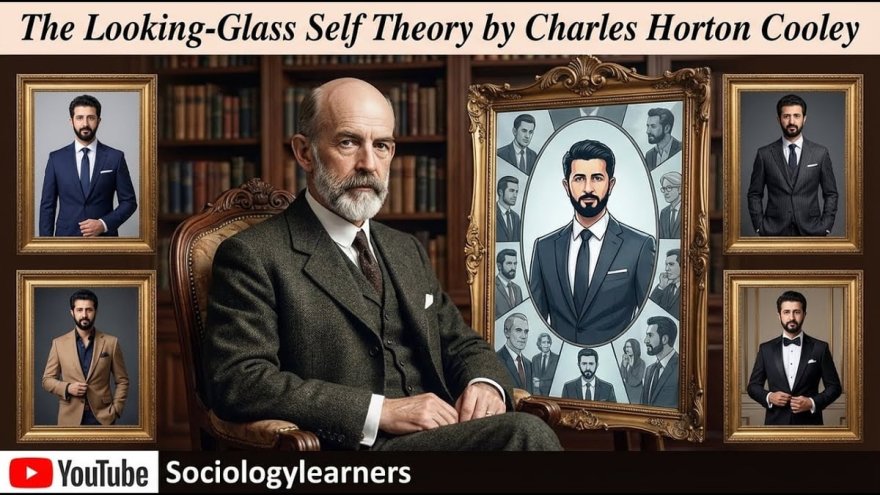
Charles Horton Cooley was an American sociologist best known for developing the concept of the looking-glass self. He was born on August 17, 1864, in Ann Arbor, Michigan, and died on May 7, 1929, in the same city. Cooley spent his entire academic career at the University of Michigan and became a founding figure of early American sociology.
Who Was Charles Horton Cooley?
Charles Horton Cooley was an American sociologist known for his humanistic approach to the study of society, which centred the role of the mind in shaping a sense of self. He was a founding member of the American Sociological Association in 1905 and served as its eighth president in 1918.
Cooley saw himself less as a sociologist and more as a scholar merging history, philosophy, and social psychology. This positioned his work differently from many of his contemporaries, who took a more objective, structural approach to the study of society.
When and Where Was Charles Horton Cooley Born?
Charles Horton Cooley was born on August 17, 1864, in Ann Arbor, Michigan. He was the son of Thomas M. Cooley, a Michigan Supreme Court Judge and founder of the University of Michigan Law School, and Mary Elizabeth Horton. He grew up in a family of considerable intellectual and legal prominence, which shaped his early exposure to scholarly pursuits.
What Was Charles Horton Cooley’s Educational Background?
Charles Horton Cooley completed his undergraduate, master’s, and doctoral studies entirely at the University of Michigan in Ann Arbor. His doctoral thesis, completed in 1894, was titled The Theory of Transportation, reflecting his early academic training in economics rather than sociology.
Cooley began teaching at the University of Michigan in 1892, despite holding a degree in economics rather than sociology, and remained at the university for the rest of his career.
What Was Charles Horton Cooley’s Academic Career?
Charles Horton Cooley taught in the sociology department at the University of Michigan from 1892 until his death in 1929. He was part of the first generation of American sociologists and helped establish sociology as a distinct academic discipline in the United States.
Cooley’s academic influences included philosopher William James, whose theory of the self he built upon and expanded. Other influences on his work included Charles Darwin, John Dewey, Ralph Waldo Emerson, James Mark Baldwin, and Herbert Spencer. He was also influenced by the transcendentalism of Henry David Thoreau.
Cooley’s work went on to influence later scholars, including psychiatrist Harry Stack Sullivan, and contributed to the development of symbolic interactionism as a sociological tradition.
What Is the Looking-Glass Self?
The looking-glass self is a concept describing how individuals develop their sense of identity based on how they believe others perceive them. Charles Horton Cooley introduced the concept in his 1902 book, Human Nature and the Social Order.
The looking-glass self develops through 3 stages.
- Imagining how one appears to other people
- Imagining the judgment other people form of that appearance
- Developing an emotional response, such as pride or shame, based on that imagined judgment
The concept functions like a mirror. Individuals do not see themselves directly but instead form their self-image through the reflection of social interaction, imagining how others see them and internalizing those imagined perceptions over time.
What Are Primary and Secondary Groups According to Cooley?
Charles Horton Cooley distinguished between 2 types of social groups in his work.
- Primary groups: intimate, close relationships such as family and friends, where face-to-face interaction shapes an individual’s values and sense of self
- Secondary groups: more goal-oriented and temporary relationships, formed around specific purposes rather than emotional closeness
Cooley argued that the ideal of moral unity in society, including qualities such as loyalty, justice, and freedom, was derived primarily from face-to-face relationships within primary groups such as the family, the neighbourhood, and children’s play groups.
What Were Charles Horton Cooley’s Major Published Works?
Charles Horton Cooley published a trilogy of major works that together outline his sociological theory. These 2 central works remain his most cited contributions.
- Human Nature and the Social Order (1902): introduced the concept of the looking-glass self and examined how the self develops through symbolically mediated interaction with others.
- Social Organization (1909): expanded on the looking-glass self and outlined Cooley’s broader theory of society, including the distinction between primary and secondary groups.
The opening sections of Social Organization were widely regarded at the time as a sociological counterpoint to the ideas of Sigmund Freud, particularly regarding the role of primary groups in shaping the individual.
What Was Charles Horton Cooley’s View of Society?
Charles Horton Cooley believed that human society functions organically, meaning it is healthy and successful when individual members act for the benefit of others rather than pursuing selfish individualism. He rejected the strict separation between the individual and society, arguing instead that the two could only be properly understood in relation to each other.
Cooley was critical of what he viewed as excessive individualism in nations such as England and the United States, arguing that this selfish individualism prevented these societies from achieving a more ideal social order.
What Was Charles Horton Cooley’s Family Life?
Charles Horton Cooley married Elsie Jones in 1890. He remained based in Ann Arbor, Michigan, for his entire life, living and working in the same city where he was born.
When and How Did Charles Horton Cooley Die?
Charles Horton Cooley died on May 7, 1929, in Ann Arbor, Michigan, at the age of 65. His death came after a battle with cancer, following a career spanning nearly 4 decades at the University of Michigan.
What Is Charles Horton Cooley’s Legacy?
Charles Horton Cooley’s legacy rests primarily on 2 concepts that remain foundational in sociology and social psychology today: the looking-glass self and the distinction between primary and secondary groups. His work laid important groundwork for symbolic interactionism, a major sociological tradition later developed further by scholars including George Herbert Mead, who was a close colleague of Cooley’s at the University of Michigan.
Although much of Cooley’s broader body of work, including his writing on communication, was overshadowed for decades following his death, recent scholarship has increasingly revisited his contributions beyond the looking-glass self, recognising him as an early and significant figure in the study of communication and social psychology.