Ascaris lumbricoides is a parasitic roundworm known for causing ascariasis, one of the most common intestinal infections in humans. Its life history consists of three main stages: egg, larva, and adult. Humans serve as the only host, and no intermediate host is required.
What Is Ascaris Lumbricoides?
Ascaris lumbricoides is a nematode that belongs to the phylum Nematoda, family Ascarididae, and order Ascaridida. It has a long, cylindrical, unsegmented body tapered at both ends. Its body is covered by a protective chitinous cuticle. Adult males measure 15 to 31 cm in length and 2 to 4 mm in diameter. Females are typically larger than males.
Where Does the Ascaris Lumbricoides Life Cycle Begin?
The life cycle of Ascaris lumbricoides begins in the small intestine of an infected human. Adult worms live and mate in the intestinal lumen. This is the site of copulation and fertilization for the species.
How Many Eggs Does a Female Ascaris Produce?
A female Ascaris lumbricoides produces approximately 200,000 eggs per day. Some sources report a slightly higher average of 240,000 eggs per day. These eggs are laid in the host’s intestine and expelled from the body along with feces.
What Happens to Ascaris Eggs After They Leave the Body?
Freshly laid Ascaris eggs contain an unsegmented ovum and are not infectious at this stage. These eggs require further development in soil to become infective. Three conditions support this development:
- Moist soil
- Warm temperatures between 20 and 40 degrees Celsius
- Shaded, humid conditions above 40 percent humidity
Under these conditions, the eggs embryonate and become infective within 10 days to several weeks, depending on environmental factors.
How Do Humans Become Infected With Ascaris Lumbricoides?
Humans become infected by ingesting food, water, or raw vegetables contaminated with infective Ascaris eggs. This transmission route is called the oral-fecal route. Only fertilized, embryonated eggs cause infection. Unfertilized eggs may be ingested but do not lead to infection.
What Happens After the Eggs Are Swallowed?
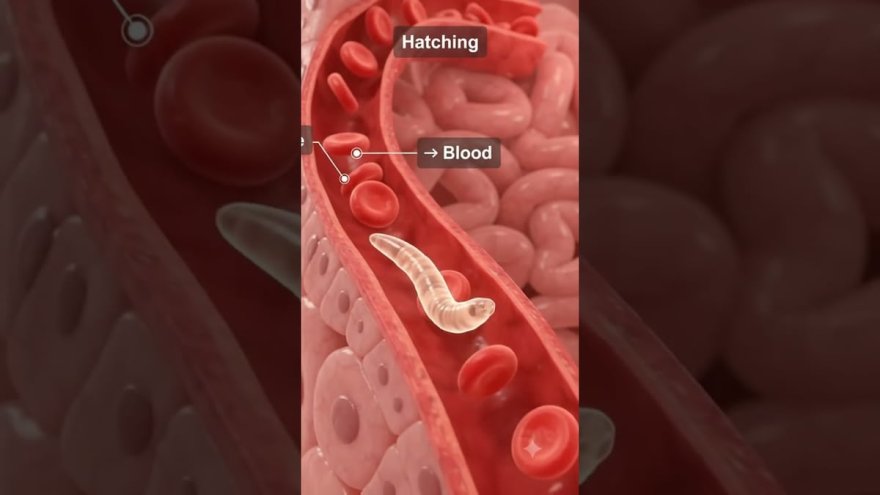
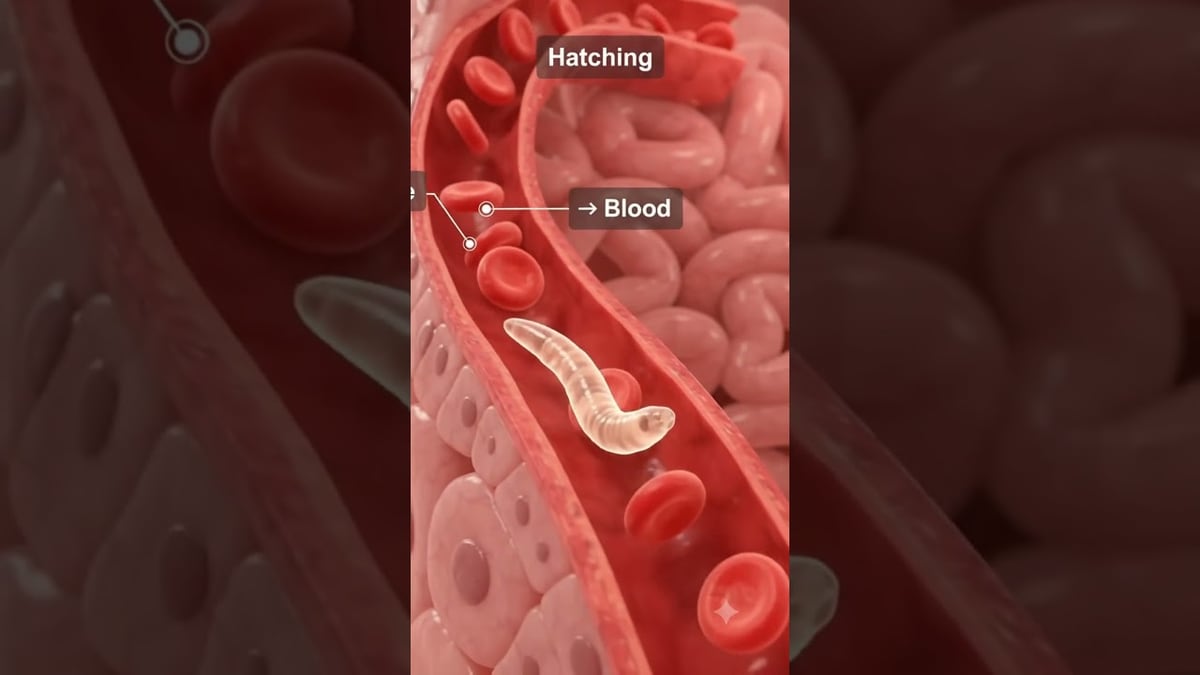
Once swallowed, Ascaris eggs hatch in the small intestine, specifically in the duodenum. This hatching releases first-stage larvae into the host’s body. The table below summarizes the larval migration stages that follow.
| Stage | Location | Approximate Timing |
|---|---|---|
| Hatching | Small intestine (duodenum) | Immediately after ingestion |
| Liver migration | Liver, via lymphatic and venous system | 3 to 4 days |
| Lung migration | Lungs, via heart and pulmonary circulation | 10 to 14 days |
| Return swallowing | Pharynx to small intestine | Around day 24 to 28 |
| Adult maturity | Small intestine | 6 to 10 weeks |
This table lists each larval migration stage, its location within the host body, and its approximate timing after infection, based on established parasitology sources.
How Do Ascaris Larvae Migrate Through the Body?
Ascaris larvae penetrate the wall of the small intestine after hatching. They then enter the lymphatic vessels and venules. From there, they travel through the host’s circulation to the liver, where they remain for 3 to 4 days. The larvae then move to the right side of the heart before reaching the lungs.
In the lungs, the larvae grow in length and molt twice, on the fifth and tenth day, to become fourth-stage larvae. These larvae then break out of the pulmonary capillaries and reach the alveoli.
How Do Larvae Return to the Intestine?
After reaching the alveoli, Ascaris larvae climb up the respiratory tract to the pharynx. The host then swallows the larvae, returning them to the small intestine. Inside the intestine, the larvae undergo a third molt, developing into fifth-stage larvae. This molt occurs approximately 24 to 28 days after the initial infection.
When Do Ascaris Larvae Become Adults?
Ascaris larvae develop and mature into adult worms within 6 to 10 weeks of infection. In total, the species undergoes four moltings across its life cycle. These moltings occur in four locations:
- One inside the egg shell, outside the host
- Two inside the lungs
- One inside the intestine
When Do Adult Female Worms Begin Laying Eggs?
Gravid female Ascaris worms begin discharging eggs in the host’s stool approximately 60 to 75 days after infection. This marks the completion of one full life cycle. The eggs passed at this stage repeat the cycle when ingested by a new human host.
How Long Do Adult Ascaris Worms Live?
Adult Ascaris lumbricoides worms can survive in the human intestine for 1 to 2 years. During this period, female worms continue laying thousands of eggs daily, sustaining transmission within a population.
What Diseases Does Ascaris Lumbricoides Cause?
Ascaris lumbricoides causes ascariasis, an intestinal infection affecting an estimated 1 billion people worldwide. Both the larval and adult stages are pathogenic. The larval migration through the lungs can cause respiratory symptoms and eosinophilia, sometimes referred to as ascaris pneumonia. The adult stage in the intestine can cause the following symptoms:
- Abdominal pain
- Fatigue
- Vomiting
- Weight loss or malnutrition
- Intestinal blockage due to large worm size
How Is Ascaris Lumbricoides Diagnosed?
Ascaris lumbricoides is diagnosed primarily through microscopic examination of a patient’s stool sample for eggs. Adult worms can also be detected in fecal or vomited material. Ultrasound imaging can assist diagnosis in cases involving pancreatic or biliary complications.
Frequently Asked Questions
What are the three main stages in the life cycle of Ascaris lumbricoides?
The three main stages are the egg stage, the larva stage, and the adult stage.
How many eggs does a female Ascaris lumbricoides lay per day?
A female Ascaris lumbricoides lays approximately 200,000 to 240,000 eggs per day.
Does Ascaris lumbricoides require an intermediate host?
No. Ascaris lumbricoides completes its entire life cycle in a single host, which is a human.
How long do adult Ascaris worms live?
Adult Ascaris worms live for 1 to 2 years inside the human small intestine.
How do humans get infected with Ascaris lumbricoides?
Humans get infected by ingesting food, water, or raw vegetables contaminated with infective Ascaris eggs.
3 thoughts on “What Is the Life History of Ascaris Lumbricoides?”